

THANK YOU FOR SUBSCRIBING
A featured contribution from Leadership Perspectives: a curated forum reserved for leaders nominated by our subscribers and vetted by our Manufacturing Technology Insights Advisory Board.


We focus on lean manufacturing on the shop floor but often overlook applications of these same methodologies to non-manufacturing processes. Our sales and distribution processes often create mura (unevenness) and muri (overburden) in manufacturing. If we do not include commercial processes in our scope we are treating symptoms not causes.
For example, a factory produces 100 widgets a day. We invest in new capabilities to produce 25 additional, upgraded super widgets a day. Our sales force tries to upsell all our existing widget customers to better and more expensive super widgets… and succeeds! Great right?
Except now we have orders for 100 super widgets but only capacity to produce 25, which will result in late deliveries, excess logistics costs and customer dissatisfaction. And at the same time we have a production line for 100 widgets with no demand, resulting in idling facilities and layoffs.
Let’s look at a real case.
One prepaid phone company distributes through a 3rd party distribution channel to approximately 10,000 independent points of sales. The company employs some 200 business developers who attend to the points of sales in their territory and grow the sales network.
This ratio of approximately 50 POS per developer was conducive towards a “road warrior” who prized being “in and out as fast as possible” in order to cover the entire area monthly.
This approach created inefficiencies and costs throughout the entire value chain. Poor demand forecasting led to inefficient production planning. Not aligning sales to production capacity resulted in low delivery performance, high overtime and excessive costs of expediting.
“The POS segmentation and determination of developer roles create a systematic method to align the independent POS on our same value chain”
There was a need to balance supply and demand across the value chain, not only in terms of volume but also in product mix. But with 10,000 independent POS, it was ineffective to pretend they were all the same, but impossible to treat them all as unique individuals.
By leveraging Nielson data and observations from the business developers, we rated all the POS on 3 characteristics:
• Potential sales (estimated total sales of all similar products at POS)
• Market share of the potential sales
• Sales health (an indicator of how well the POS shares end customer information, forecasts demand, carries the product mix we want to sell, etc)
Incorporating the health axis into the analysis allows us to measure many of the root causes of variability that add cost and complexity to manufacturing.
Based on where each POS falls in the pyramid below we determine what “profile” the business developer should assume to best manage that POS. 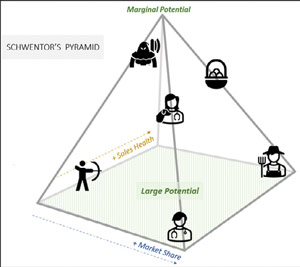
Farmer:The farmer profile is best suited to manage large potential POS where we are happy with our position, that is we have significant market share and healthy sales. These relationships need to be invested in to be cultivated and grown.
Hunter: The hunter profile is ideal for large potential POS where we have low market share. The developer needs to be opportunistic to aggressively grow our stake in the POS.
Doctor:The doctor manages those large potential POS where we have significant market share but our sales are not healthy. Something is causing inefficiency in our processes: infrequent and too big orders, poor demand forecasting, unbalanced product mix, etc. The doctor diagnoses the illness and cures it while keeping the patient alive and well.
Gatherer: The gatherer profile is for POS with marginal potential but where we have significant market share and healthy sales. The gatherer stops by, collects what’s easy, says a few words of encouragement and moves on. Attendance and maintenance of the status quo, but low investment.
Veterinarian:The veterinarian profile is for marginal potential POS where we have market share but the sales are not healthy. There is a health problem that needs to be solved. The vet should diagnose the illness and attempt to treat, but if the cost of the solution is too steep it’s time to put the patient to sleep.
Executioner: For marginal potential POS where we don’t have any market share to speak of. Pull the plug. Maybe send some info on how to order online and targeted advertisement, but it is not worth investing a business developer’s time in these POS.
Each business developer in their territory will have multiple POS in each category, so they will need to adopt different roles for each one. With the proper role specific standard work they can give custom treatment on a mass scale, and will systematically lead all their POS towards increased and more stable demand.
The health axis creates a direct link from manufacturing through sales to align the entire organization to the value chain. The POS segmentation and determination of developer roles create a systematic method to align the independent POS on our same value chain. We can now return to the shop floor with less unevenness in our demand.
The health axis creates a common KPI linking manufacturing, planning and sales to align our entire organization to the value chain. The POS segmentation and determination of developer roles create a systematic method to align the independent POS on our same value chain. We can now return to the shop floor with less unevenness in our demand.

Manufacturing Technology Insights Weekly Brief
Be first to read the latest tech news, Industry Leader's Insights, and CIO interviews of medium and large enterprises exclusively from Manufacturing Technology Insights
